15 Sense of Taste Coloring Pages - Free!
The 5 Senses of the Human Body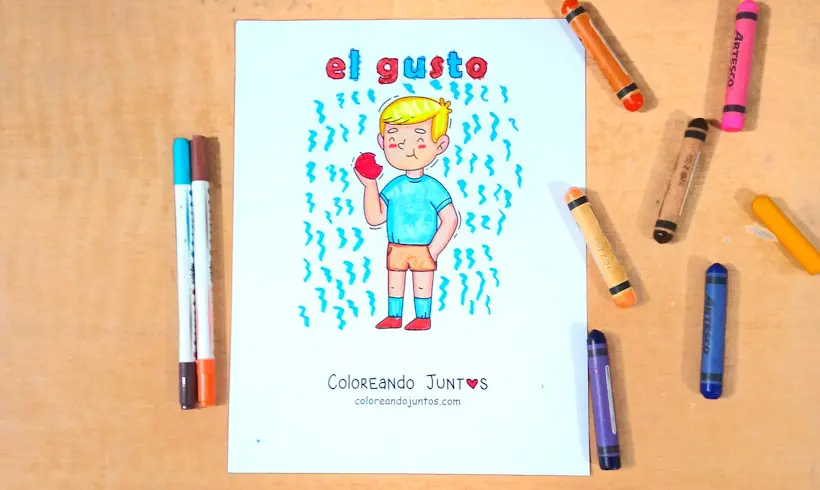
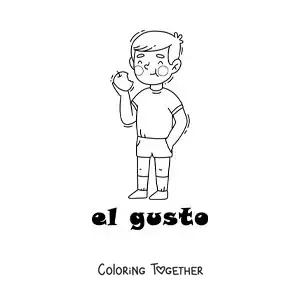
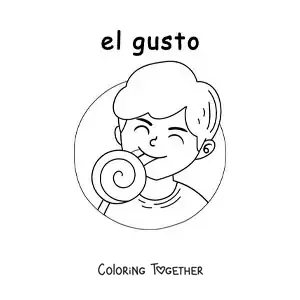
What do you most like to eat? Surely you have an answer to this question, because the sense of taste is one of the most pleasurable ones we have. Better let this boy eating his apple confirm it for you, he looks so happy! Do you think we did a good job coloring him?
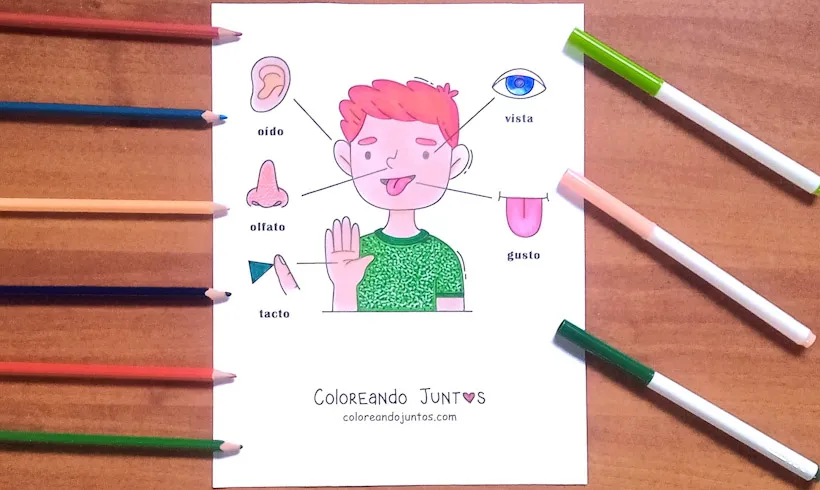
At Coloring Together we want you to learn more about this wonderful sense, which is why we have prepared a very special gallery. In it you will find sense of taste coloring pages, which will teach you how it works and what parts make it up.
You will also find drawings of the sense of taste for kids, which will show you how we can enjoy the different flavors that nature offers us.
And if you need drawings of the sense of taste with its parts for your school assignments, we have those too! You only have to choose the one you like best and download it. Then it is a matter of choosing a technique, whether simple like coloring in circles or challenging like mosaic. It will look great!
But that is not all, at Coloring Together we also want to see your artistic talent. That is why we invite you to send us your sense of taste coloring pages, and we will put them in our special gallery. You only have to take a photo and send it. We will love to see your work!
Do not miss this opportunity to learn and have fun coloring. Later, when you are tasting your favorite candy, you will already know why it feels sweet to you. Let's learn by coloring!
The Sense of Taste coloring pages

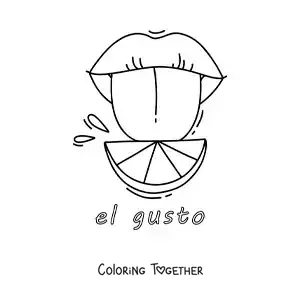
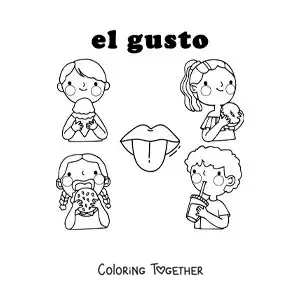
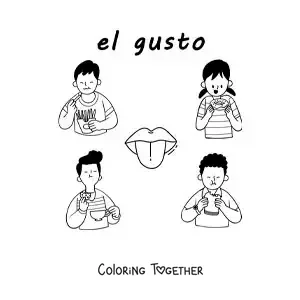

Why color the sense of taste pictures?
The sense of taste is the ability to perceive the flavors of foods and beverages, as well as to detect whether something has gone bad or whether we like it or not. It is quite simple! Right?
The sense of taste is based on four primary flavors: sweet, salty, sour and bitter. However, there is a fifth flavor called umami, which means "savory" or "delicious" in Japanese. Umami is due to glutamate, an amino acid released by certain foods such as parmesan cheese, tomatoes, meat or mushrooms.
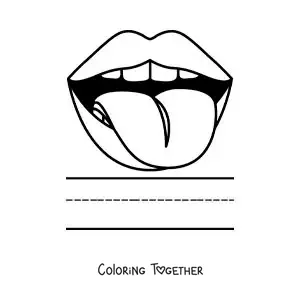
The sense of taste is not the same as flavor. Flavor is the combination of the stimuli we receive from all our senses when eating, especially from smell. Wait! We are out of lines, but do not worry! At Coloring Together we always have a plan B.
If you decide to color the sense of taste coloring pages, you will find fun facts above the images, which will contain very important and interesting information about the sense of taste. Run and taste a little of the flavor of knowledge!
Learn while coloring The Sense of Taste
- Taste is based on four primary flavors: sweet, salty, sour and bitter. However, there is a fifth flavor called umami, which means "savory" or "delicious" in Japanese.
- Taste is not the same as flavor. Flavor is the combination of the stimuli we receive from all our senses when eating, especially from smell. That is why when we have a cold or a stuffy nose, food tastes different or less intense to us.
- To perceive taste we need saliva, which is the medium that dilutes the chemical molecules of foods and carries them to the taste buds.
- Adults have around 10,000 taste buds, which regenerate every two weeks. As we age, we lose taste buds and the ones that remain become less sensitive.
- The umami flavor was discovered in 1908 by the Japanese scientist Kikunae Ikeda, who identified glutamic acid as the substance responsible for this flavor.
- The tongue is not divided into zones according to the flavors it perceives, as was once believed. All parts of the tongue can detect all flavors, although there are some zones more sensitive than others.
- The brain is what really tastes, since it interprets the signals sent to it by the receptors of the mouth and nose.
- Taste can be trained or educated to better appreciate flavors and enjoy food more. Some ways to do this are trying new or different foods, eating slowly and with full attention, chewing well and using all the senses when eating.
- Obesity is related to a change in the sense of taste, since sensitivity related to the area of sweet flavors is lost.
- A group of scientists in Singapore developed a digital simulator that allows the flavor of food to be transmitted virtually to the tongue. Incredible!
- Most people who go to the doctor because they think they have lost their sense of taste have actually lost their sense of smell. However, there are taste disorders, such as dysgeusia, in which there is a persistent bad taste in the mouth, and hypogeusia, in which the ability to taste is reduced.
- Although taste buds regenerate constantly, it has been discovered that by the time you reach 20 years old, you will have lost approximately half of the taste buds you had when you were a baby.
- When you are at an altitude of 10,000 meters, the sense of smell and that of taste are the first to be affected due to the lack of humidity, the low pressure and the background noise.
- The Physiology of Taste is a work written by J. Anthelme Brillat-Savarin and published in 1825. This work is considered the first to address in a global and exhaustive way the pleasure produced by the sense of taste and the passion for good food.
- The utensil we use to eat can influence the flavor of the food. For example, if we eat yogurt with a plastic spoon, we feel it is thicker; if the yogurt is white and is eaten with a white spoon, it is perceived as sweeter.