15 Sense of Hearing Coloring Pages - Free!
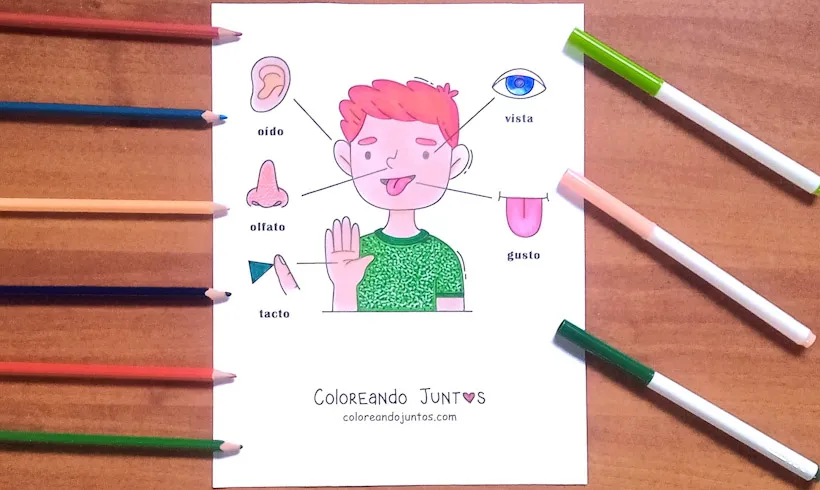
The 5 Senses of the Human Body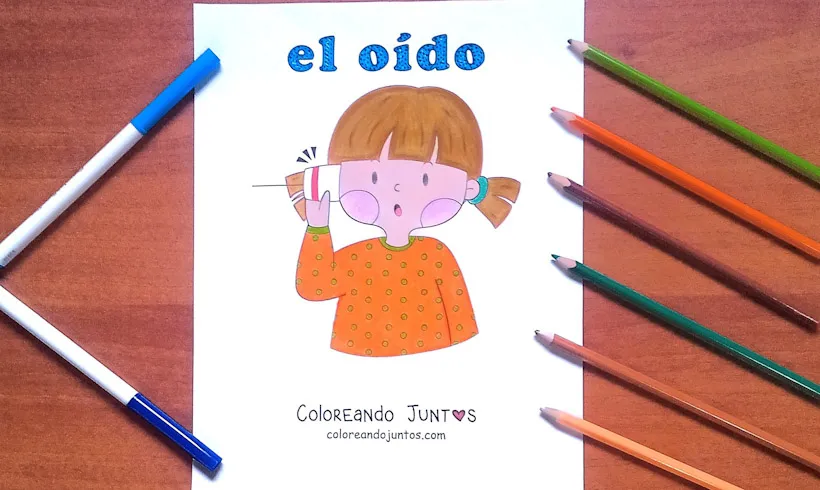
Have you already heard about the new drawing we colored this time? This little girl is paying close attention to the great advice we give at Coloring Together. Do you think we did a good job painting her? You can paint her your own way!
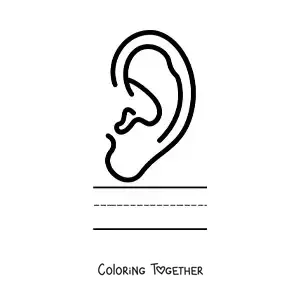
So you can practice your skills comfortably, in this gallery we have gathered a wide variety of ear coloring pages and animated ear coloring images that will listen to your new ideas with lots of enthusiasm.
To color these animated ears, you can use foam and with a hole punch make small circles and stick them on without going outside the lines. It will turn out great! Although if you prefer to use your wax crayons, remember that if you color in layers you can make backlight shadows.
Once you have finished your new work of art, would you like to share your talent with the world? Then, send us a photo of your printed and colored drawing of the sense of hearing! We are sure your skills can inspire the artists of future generations. Don't let shyness hide your gift!
Now then, do you already have your materials on hand? Excellent! The ear coloring images are already tired of hearing the rumors about how good you are. It is time to show everyone your skills! So don't waste any more time. It is time to color!
The Sense of Hearing coloring pages











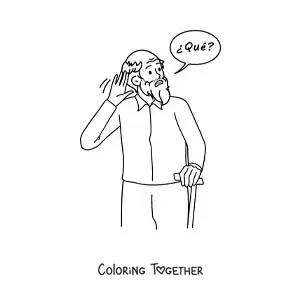

Why color the sense of hearing pictures?
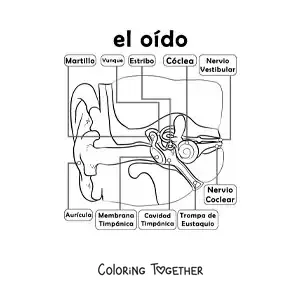
The ear is the organ in charge of hearing and balance. This organ is divided into three parts: the outer ear, which lets us receive sounds; the middle ear, which transmits the vibrations; and the inner ear, which transforms the sounds into nerve signals that are interpreted by the brain
Some studies indicate that we hear differently between the right ear and the left ear. With the right ear we better capture discontinuous sounds, like speech, while with the left we better hear continuous sounds and music
Since at Coloring Together we know you enjoy listening to the pleasant sounds around you, this time we have gathered the best ear coloring pages. That way, you can fine-tune your ears while practicing your skills as an artist.
And as an extra gift, on top of each of the ear coloring images you can find little snippets of information that will help you broaden your knowledge about this incredible organ that lets us enjoy the sounds around us.
Learn while coloring The Sense of Hearing
- Our body's balance center is the ear.
- The smallest bone in the human body is located in the ear. It is called the stirrup or stapes and it is between 2.5 and 3 mm long.
- Some scientific studies point out that people with high levels of triglycerides and cholesterol are more likely to suffer from hearing problems.
- Diseases or surgical procedures in the ear can cause an alteration in the sense of taste.
- The wax moth is the living being with the best hearing in the world. These animals are able to hear ultrasound up to 300 kHz in frequency. Impressive!
- The human ear has three bones: the hammer, the anvil and the stirrup. These are connected and they move or vibrate in reaction to sound waves.
- The wax produced inside our ears is a way of protecting the ear canal from the entry of insects, dust, bacteria, etc.
- It is not recommended to use cotton swabs or any other object to clean the wax from your ears, since they have their own cleaning system through cilia that expel the excess wax.
- As a defense mechanism, our ears never sleep. The brain is in charge of blocking everyday sounds and waking us up if it hears something out of the ordinary.
- Spiders do not hear through their ears in the conventional way. In fact, jumping spiders, fishing spiders and ogre-faced spiders hear through nerve receptors they have on their legs.
- The hearing range of a human ear is 20 to 20,000 Hz, while the range of some animals can reach 50,000 Hz.
- The ear is made up of three parts: the outer ear, which lets us receive sounds; the middle ear, which transmits the vibrations to the inner ear; and the inner ear, which transforms the sounds into nerve signals interpreted by the brain.
- Various studies point out that we hear differently between the right ear and the left ear. With the right ear we hear discontinuous sounds, like speech, while with the left we better hear continuous sounds and music.
- One way to strengthen the blood vessels of the inner ear is by consuming fatty acids with Omega 3. Some of these foods can be fish and flaxseed.
- The shape of human ears is not by chance, since their folds and structure allow the ear to perceive nearby sounds more easily.
- Hearing is the last sense lost before dying.