10 Microscope Coloring Pages - Free!
Science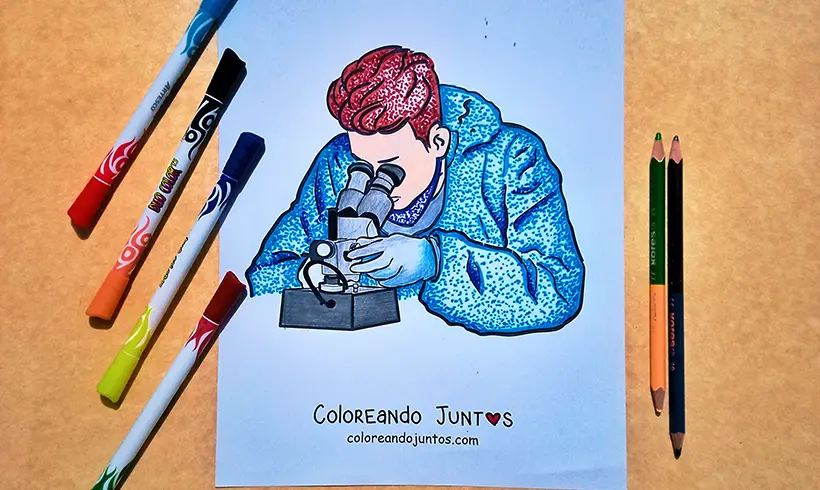
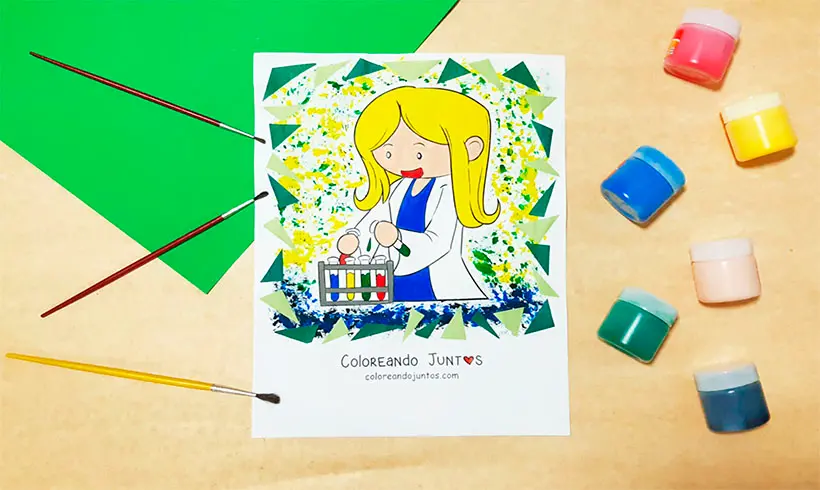
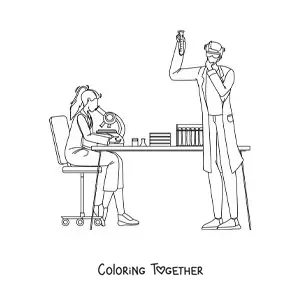
Do you like the way we colored this scientist looking through a microscope? We had so much fun! We are sure you can make one just like it or similar, so don't hesitate to use whatever techniques you like best.
We know there are many little scientists out there with great intelligence and a real eagerness to learn. If you are one of them, you will surely love this topic, because we have gathered microscope coloring pages, so you can get a little closer to a whole new world. It will be super amazing!
Microscopes let you observe in detail the makeup and shape of many of the things around us, and at the same time study these forms of life. Thanks to them we know many types of cells, did you know that?
If you want to learn more about microscopes, then you have come to the right place, because we have not only gathered the best microscope coloring pages on the web, but we have also added fun facts about these devices that will leave you amazed at how surprising they are.
At Coloring Together we have more than microscopes. If you dare to explore the many colorful galleries we have available, you will find coloring pages on every theme you can imagine. Come on and have fun with us!
Science is research, trial and error, and finally revealing it to the world. Why not show others your beautiful colored drawings? Maybe they will be an inspiration for others, and an invitation to do the same. We have a whole gallery for that beautiful art!
If you are ready, it's time to do experiments. Choose all the materials you want, and after making some mixtures, let's take a sample to look at through the microscope. But first, add some color! That way it will work much better.
Microscopes coloring pages
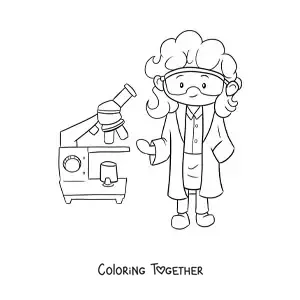
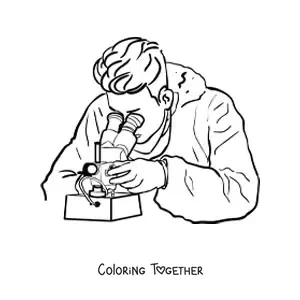
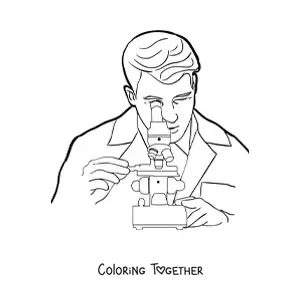
Why color pictures of microscopes?
Microscopes are instruments used in science, and their creation was a real advance for society. Having a microscope is very useful! Or at least if you are interested in science and have curiosity big enough to investigate what lies beyond what we see. Are you that curious?
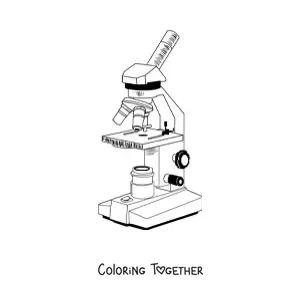
A microscope is made up of several lenses that work together, so you can observe cell structures that you couldn't come close to seeing with the naked eye. Thanks to this, it has been possible to study the microscopic living beings that inhabit all kinds of places.
Since we know that microscopes are very useful instruments, we have gathered a variety of microscope coloring pages. Don't be afraid to let your inner scientist out, and let art combine with science to create the most astonishing drawings!
Come on! If you color these microscope coloring pages you will learn a ton from the fun facts we added on top of the printable coloring pages. New knowledge and a great opportunity to practice your art, there is nothing that can stop you!
Learn while coloring Microscopes
- Actually, it's impossible to say who the true inventor of the microscope was, because many people throughout history built devices similar to the microscope we know today. Some believe it was Zacharias Janssen, others say it was Hans Lippershey.
- In 1609 Galileo Galilei presented an optical microscope, whose design consisted of combining a concave lens with a convex one.
- Thanks to the microscope, in 1906 studies on Alzheimer's were presented, in which the symptoms were related to changes in the structure of the cerebral cortex. Observed through a microscope!
- Under the microscope, two strains of the human papillomavirus were isolated in 1983. Thanks to this work, carried out by Zur Hausen, we now have vaccines that can prevent infections related to the virus.
- The Dutchman Anton van Leeuwenhoek was the first to use microscopes to describe organisms, protozoa, bacteria, sperm cells, and red blood cells. So much diversity!
- Robert Hooke was one of the first scientists to use the microscope for scientific purposes. In 1665 he published a book titled “Micrographia,” which had illustrations of his observations through a compound microscope. This book included insects and plants.
- The electron microscope was developed in Germany in 1931. It is the most powerful microscope, since it has greater magnification and higher resolution compared to other microscopes.
- Anton van Leeuwenhoek is considered the father of microbiology for all the contributions he made through the microscopes he built himself. The most curious thing of all is that he kept his lens-making techniques secret.
- In 1776 the Briton Jeremiah Sisson built the first revolving nosepiece for microscopes, which made it possible to change the objective used to observe the sample. How useful that is!
- The first prototype of the electron microscope was built in 1931 by the physicist Ernst Ruska and the engineer Max Knoll. Two years later they managed to build the first electron microscope that surpasses the optical one in resolution.