20 Forest Coloring Pages - Free!
Nature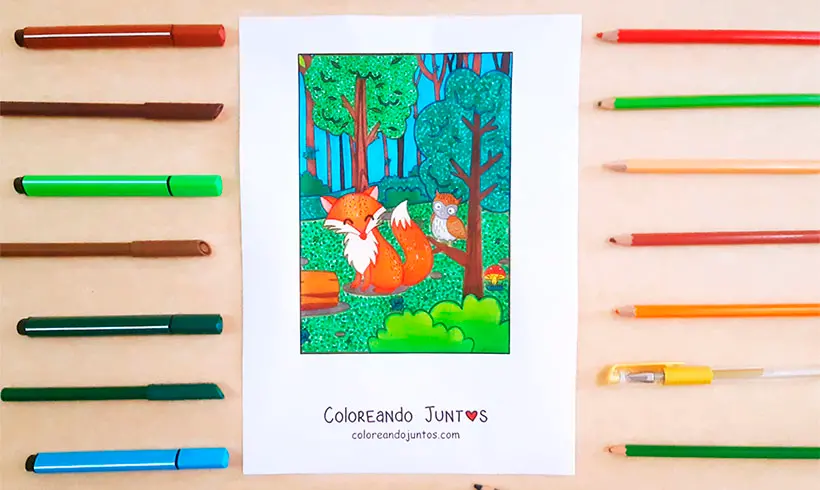
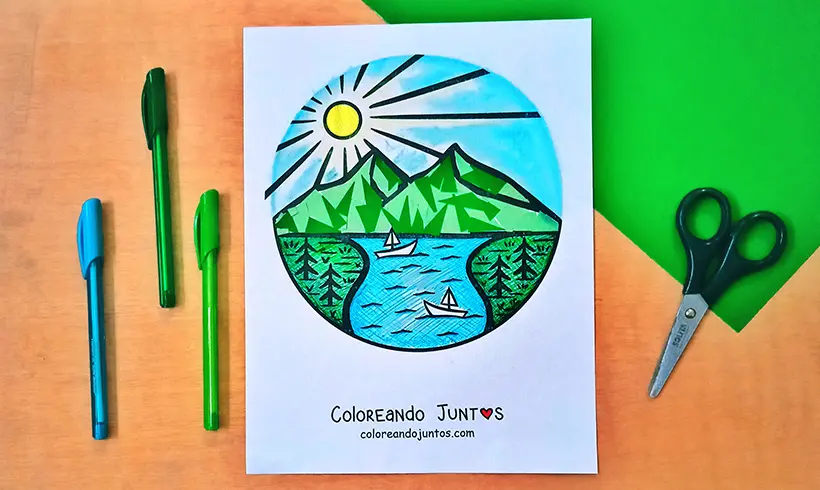
What do you think about the forest we've painted? Do you think it's colorful enough for all its animals to be able to live happily and comfortably?
We're eager to see which techniques you're going to use to paint your own forest. We're sure that the animals living in it will feel satisfied to be in such a magical and creative place.
Do you already know which materials you'll use to paint the foliage of the trees? Could it be pieces of glossy paper to make them look shiny and full of life? Or will you use little balls of crepe paper to make them look very lush? You could even use a couple of dried leaves to give a hyperrealistic effect!
Whatever you decide will make your forest coloring pages the most beautiful in the world. In our gallery you'll find a ton of enchanted forest drawings, realistic forest drawings, and forest drawings for kids to shine with.
You'll have hours and hours of fun! But don't let that make you forget that you must send us the printable coloring pages that you painted most beautifully.
Remember that we like to upload the drawings of our followers to our website; and the collection wouldn't be complete without the images of the best artist!
Forests coloring pages
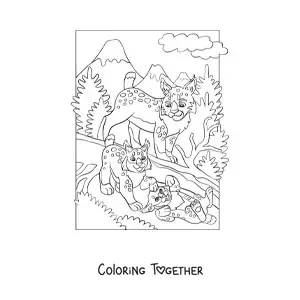

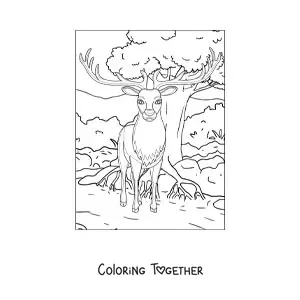
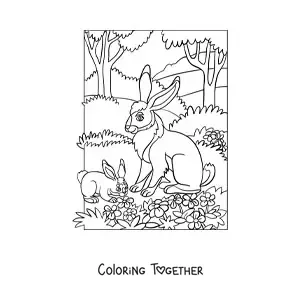
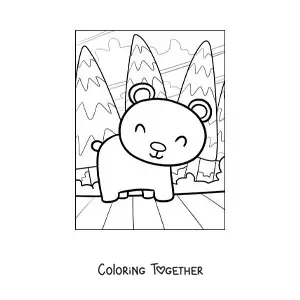
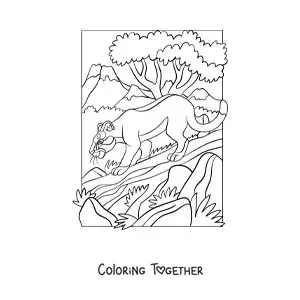
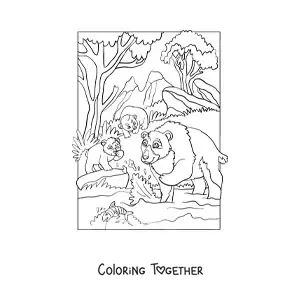

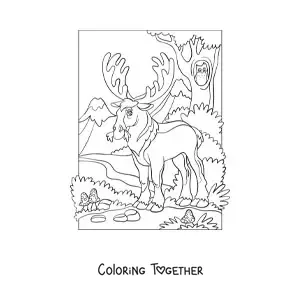
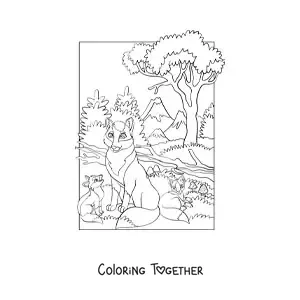
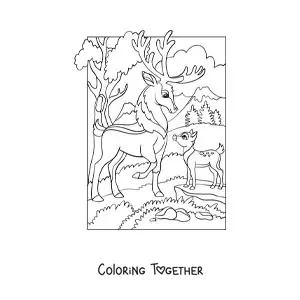
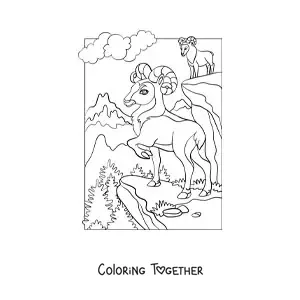
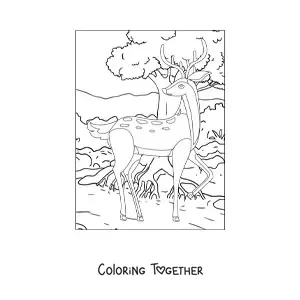
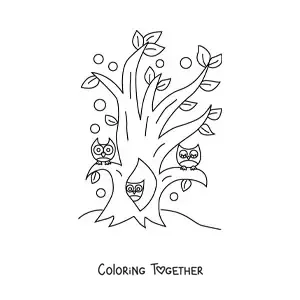
Why color forests pictures?
Forests are essential! They give a home to millions of species, provide the oxygen we breathe, and help improve the quality of the air, water, and soil. In addition, they are necessary to fight climate change and provide work and resources to millions of people.
From forests we can obtain wood and a great variety of fruits, flowers, vegetables, and medicinal plants. They also allow us to relax and be closer to nature. What would we do without these wonderful, green spaces?!
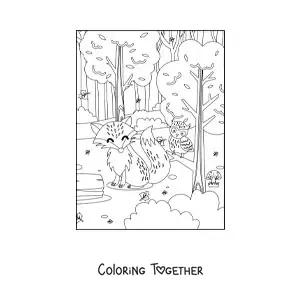
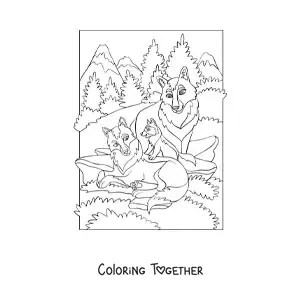
At Coloring Together we love them! And since we know you do too, we've put together a beautiful gallery full of forest coloring pages.
You'll be able to put your artistic skills to the test while learning lots of new things! Remember that each of these forest coloring pages comes with a most interesting fun fact. Read them all and become an expert!
Are you ready for this exciting forest adventure? Go get your art materials and let's bring all these forests to life.
Learn while coloring Forests
- The densest forests in the world are found in the United States. They are located in Jedediah Smith Redwoods State Park, Redwood National Park, and Humboldt Redwoods State Park. Their average density is estimated at more than 4,000 tons of trees per hectare.
- The largest coniferous forests in the world are located in northern Russia. In addition, it is estimated that 20% of the world's total forests are found in this country.
- It is estimated that forests occupy 31% of the total surface of the Earth. That's about 4 billion hectares of wooded areas. Incredible!
- According to Peru's Ministry of the Environment, 60% of the planet Earth's wooded areas are distributed across just 7 countries.
- Taking their climate into account, we can classify forests into four types: temperate forests, boreal forests, tropical forests, and subtropical forests. What types of forests are there in the country where you live?
- Taking into account the level of human intervention and impact, we can classify forests into three main types: primary or virgin forests, secondary forests, and artificial or cultivated forests.
- According to the altitude at which they are found, we can classify forests into two main types: basal or lowland forests and montane or mountain forests.
- Depending on the type of vegetation they have, we can classify forests into three main types: coniferous forests, broadleaf forests, and mixed forests.
- Depending on the foliage of the trees that make up the forests, we can classify them into two large types: evergreen forests and deciduous forests.
- Did you know that the temperature of subtropical forests ranges between 17C and 24C? Tropical forests are usually a bit hotter, since their temperature ranges between 24C and 27C.
- The countries that hold the largest amount of wooded areas are Russia, Brazil, Canada, the United States, China, Australia, and the Congo.
- The main causes of forest deforestation worldwide are logging for agriculture, logging for livestock, logging for urban expansion, logging for mining and oil activity, and logging to obtain wood.
- According to the University of Maryland, in 2020 more than 4.2 million hectares of primary tropical forests were lost. To save our planet, we must stop massive deforestation immediately!
- It is estimated that more than one and a half billion people depend on forests to sustain themselves. Studies confirm that 3/4 of the world's population uses wood as their main source of energy!
- It is calculated that the world's jungles and forests are home to about 80% of animal and plant species. They are true biodiversity hotspots!
- Did you know that in Ethiopia between 100,000 and 200,000 hectares of forest are cut down every year?
- Did you know that around 95% of the continental forests of the United States have been cut down in the last 500 years? It's a most alarming figure!
- The United Nations Environment Programme (UNEP) states that the Earth has lost about 80% of its primeval forests.
- Some of the most representative mammal species of the boreal forests of Canada are the moose, the wolverine, the caribou, the brown bear, the arctic fox, the wolf, the boreal raccoon, the American mink, the Canada lynx, and the common weasel. Which of them all is your favorite?
- Did you know that underwater forests exist? They are populated by different species of algae and are estimated to be eight times more productive than tropical forests. Unfortunately, they degrade at an alarming rate due to pollution, trawl fishing, overgrazing, and urban expansion.